


If the outside of your house is looking tired, stained, cracked or simply past its best, the obvious question is often: “What should I put on it?”
Should you paint it?
Have it rendered?
Or is a protective wall coating a better option?
The answer is that there is no single treatment that is right for every house.
The condition of the existing wall, the type of surface, previous repairs, exposure to weather and the cause of any damp or deterioration all matter.
After decades of working with exterior walls, one lesson is particularly important: do not choose the finish before understanding the wall.
A good-looking coating cannot compensate for loose render, persistent water ingress or an underlying building defect.
The short answer
Paint is generally suitable when the existing surface is sound and mainly needs colour or cosmetic renewal.
Rendering is appropriate when a wall needs a new render surface or substantial repair, provided the chosen render is suitable for the building.
A protective wall coating may be worth considering when an existing sound surface needs decorative improvement together with additional resistance to weathering and water penetration.
The correct choice depends on the wall underneath, not simply on how it looks from the road.
Before choosing a finish, find out what is actually wrong
This is where homeowners can easily spend money in the wrong order.
A wall that looks unattractive may have nothing more seriously wrong with it than an old, faded finish.
Another wall can look reasonably sound while harbouring cracks, failed repairs or areas where moisture is getting into the building fabric.
Before deciding between masonry paint, rendering or a protective coating, look for:
- cracks or movement in the render
- loose, hollow or blown areas
- flaking or peeling paint
- moss, algae or persistent staining
- water marks or areas that remain damp
- failed sealant around openings and joints
- previous repairs that are breaking down
- differences in texture or colour across the elevation
It is also important to establish whether apparent damp is actually being caused by the exterior wall.
Condensation, leaking gutters, defective pipes, roof problems and plumbing faults can all produce symptoms that are wrongly blamed on render or paint.
Important: paint does not cure damp
If a wall is persistently damp, simply applying another coat of paint is not a proper diagnosis or cure. The source of the moisture needs to be identified first.
That might mean investigating gutters, downpipes, pointing, cracks, external ground levels, plumbing or the condition of the render itself.
When is masonry paint the right choice?
Masonry paint is usually the simplest option when the existing wall surface is sound and the main requirement is a change or renewal of its appearance.
Modern masonry paints are designed for exterior mineral surfaces such as render, brick and concrete.
Depending on the product, they can provide colour retention and resistance to normal weather exposure.
However, paint is only as good as the surface beneath it.
If old paint is failing, the wall is contaminated with organic growth, or sections of render are loose, those problems need attention before painting.
Painting over defects can hide them temporarily rather than solving them.
When does a house need rendering?
Rendering creates a new protective and decorative surface over the underlying wall.
It can be appropriate where the existing render has failed extensively, where a different render system is required, or where a building is being newly rendered.
There are many different types of render, and they should not be treated as interchangeable materials.
The construction of the property matters.
An older solid-wall building, for example, may need a different approach from a modern cavity-wall house. The existing substrate, movement, moisture behaviour and compatibility with previous materials all need consideration.
One of the most common mistakes is assuming that applying a new material over an old problem automatically fixes it. It doesn’t.
Before substantial rendering work begins, the cause of any cracking, water penetration or deterioration should be established and addressed.
What is a protective wall coating?
A protective wall coating is a specialist exterior finish applied to an appropriate prepared surface to provide both a decorative finish and additional protection from weather exposure.
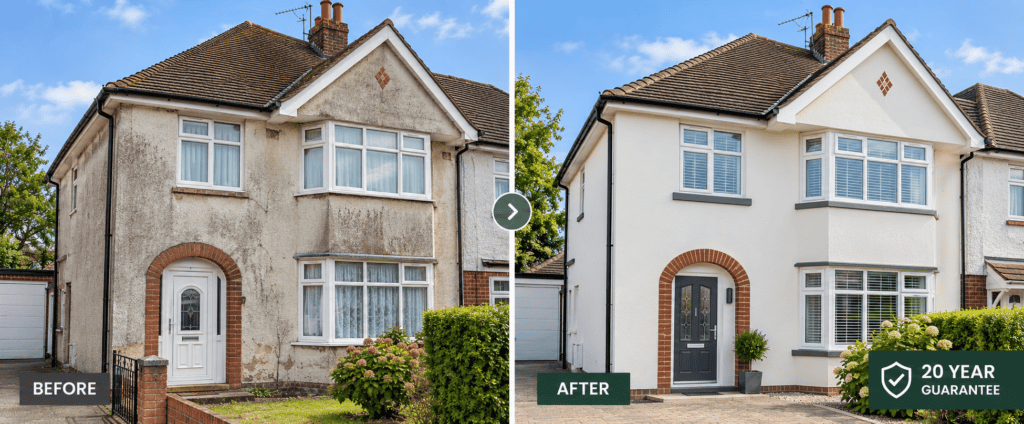
Unlike ordinary masonry paint, some coating systems are formulated to create a more substantial textured or protective finish.
The exact properties vary considerably between products, so homeowners should look at the manufacturer’s technical information rather than assuming that every coating performs in the same way.
Some systems are designed to help reduce water penetration while allowing a degree of water vapour movement.
This distinction matters because a wall needs to manage moisture appropriately rather than simply being sealed without consideration of the building.
A useful way to think about the three options
Paint: “The wall is fundamentally sound; I want to renew its appearance.”
Render: “The wall needs a new or substantially repaired surface.”
Protective coating: “The existing surface may be suitable for refurbishment and I want a decorative finish with additional protective properties.”
These are starting points, not rules. The condition and construction of the individual property always come first.
Which is best for an older house?
This is one of the questions I would always answer with another question: what is the house made from?
Older properties can behave very differently from modern buildings.
Solid masonry, traditional mortars, older renders and later cement-based repairs can interact with moisture in different ways.
That is why “waterproofing” should never be treated as a simple objective in isolation.
The aim should be to manage rainwater and moisture appropriately while choosing materials that are compatible with the building.
On an older property, it can therefore be particularly important to understand the existing construction before choosing between painting, rendering or a coating system.
Can you paint over old render?
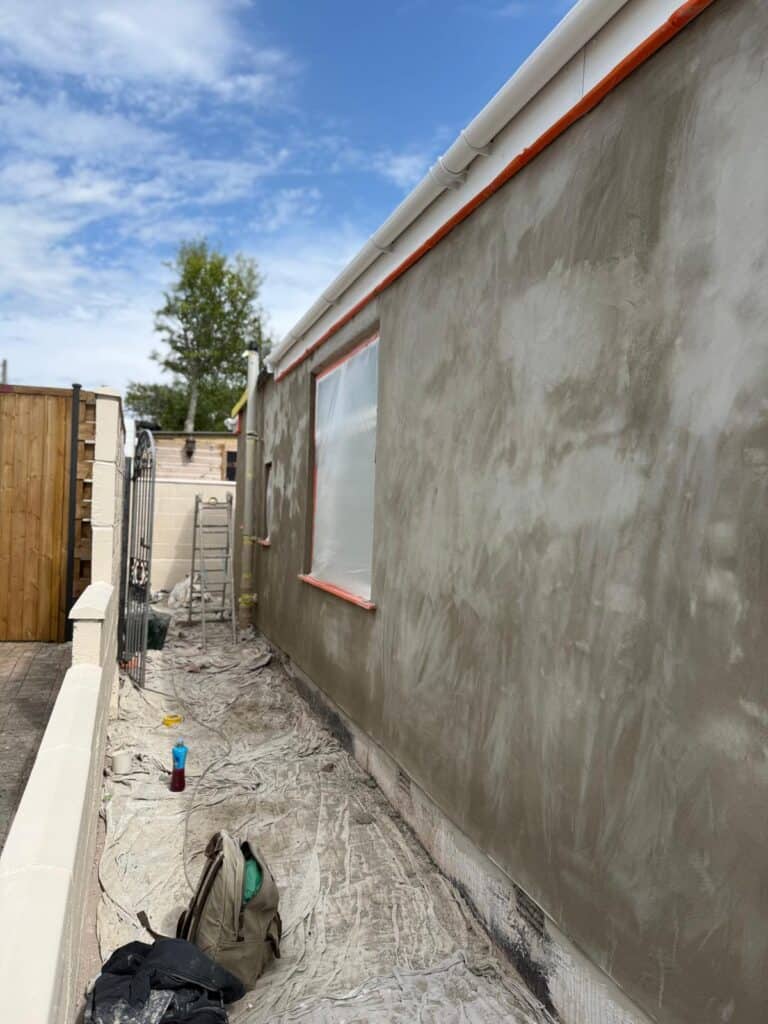
Yes, provided the render is sound, suitably prepared and compatible with the proposed paint.
Old render should be checked for loose areas, cracking, contamination and previous coatings that may affect adhesion. Surfaces may need cleaning, repairs and preparation before a new finish is applied.
Simply applying another coat over failing paint is rarely a sensible long-term solution.
Does a wall coating stop damp?
Not necessarily, and no responsible contractor should promise that a coating will cure every damp problem.
A suitable exterior finish can help reduce the amount of rainwater reaching an appropriate wall surface, but damp can have many causes. Rising damp, plumbing leaks, defective rainwater goods, condensation and structural defects require different investigations and solutions.
If damp is the concern, deal with the source first. A coating should be considered as part of an overall approach to the external wall, not as a universal damp cure.
What about Britain’s weather?
Exterior walls have a difficult job. They have to cope with driving rain, wind, frost, repeated wetting and drying, seasonal temperature changes and biological growth.
The South West can be particularly demanding because exposed properties may receive considerable rainfall and wind-driven moisture, while coastal locations introduce additional environmental exposure.
This is why the choice of exterior finish should consider weather exposure as well as appearance.
Good preparation, sound repairs and a finish appropriate to the substrate are usually more important than simply choosing the most expensive product.
So, which option should you choose?
There is a useful decision-making process that homeowners can follow.
- Identify the existing surface. Is it render, painted render, pebble dash, brick, block or another masonry finish?
- Check its condition. Look for cracking, loose material, damp and failed previous repairs.
- Find the cause of problems. Do not assume every stain or damp patch is caused by the wall finish.
- Consider the construction. Older and modern properties may require different materials and approaches.
- Decide what you actually need. Cosmetic renewal, substantial repair, a new render surface or refurbishment and protection are different objectives.
- Choose the finish afterwards. The product should follow the diagnosis, not the other way around.
The biggest mistake homeowners make
It is tempting to start with the question, “Which product should I use?”
A better question is “What does this wall actually need?”
That small change in thinking can prevent an inappropriate finish being applied to a surface that first needs repair, cleaning, investigation or preparation.
Frequently asked questions
Is rendering better than painting?
No. Rendering and painting perform different jobs. Rendering provides a new surface, while masonry paint is normally used to decorate and protect a suitable existing mineral surface. The condition of the wall determines which is appropriate.
Is a protective wall coating better than masonry paint?
Not automatically. Some protective coating systems offer properties that conventional masonry paint does not, but the right choice depends on the wall, the existing finish, preparation requirements and the properties required from the new surface.
Should I re-render my whole house if the render looks old?
Not necessarily. If the existing render is fundamentally sound, repair and refurbishment may be possible. However, extensive failure or underlying defects may make more substantial work appropriate.
Can exterior wall coatings be applied to pebble dash?
Some systems can be applied to suitable pebble dash or textured surfaces, but compatibility and preparation must be established first. Loose material, contamination and failed previous coatings should not simply be covered up.
What is the best exterior finish for a house?
There is no universally best exterior finish. The appropriate choice depends on the building construction, existing surface, condition, exposure to weather, moisture behaviour, appearance required and maintenance expectations.
A better way to approach exterior house maintenance
Your home’s exterior is not just decoration.
It is part of the building’s first line of defence against weather, and the finish you choose should work with the wall rather than simply cover it.
Whether the right answer turns out to be masonry paint, repairs, new rendering or a protective coating, the sensible starting point is the same: understand the existing wall before deciding what to put on it.
At Render Refresh, our approach is centred on assessing existing rendered and masonry surfaces and identifying what work is actually appropriate.
If you are considering renovating the outside of your home, you can contact Render Refresh to discuss the condition of your exterior and the options available.
Leave a Reply